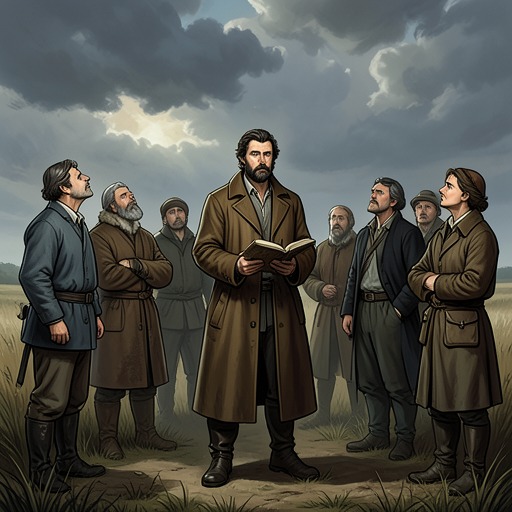
Samuel H. Smith
Under the Banner of HeavenSamuel H. Smith was Joseph Smith’s younger brother and a briefly pivotal figure in the church leadership contest that followed Joseph’s murder. As anti-polygamy leaders sought to secure the succession before the apostles returned to Nauvoo, they turned to Samuel; his sudden death on July 30, 1844, removed their preferred candidate at a decisive moment. The account raises a poisoning allegation but describes it as circumstantial, not established fact.
Identity and the Succession Crisis
Samuel’s significance in the narrative rests on his place in Joseph’s family and on the competing claims to lead the church after Joseph’s death. The anti-polygamy faction wanted a successor who would not uphold plural marriage. Joseph Smith III, the deceased prophet’s young son, had the strongest hereditary claim, but had not yet reached puberty. The faction therefore focused on Samuel, Joseph’s younger brother, as a possible leader who could preserve its position.
The contest unfolded while much of the Quorum of the Twelve Apostles, including Brigham Young, was away from Nauvoo. Joseph had sent them across the country to gather support for his presidential campaign. Young was in Massachusetts when Joseph was shot and did not learn of his death until nineteen days later. Once news reached the apostles, they hurried back, creating a narrow interval in which other factions tried to determine who would lead the church.
Candidacy and Sudden Death
The anti-polygamy faction worked to have one of its own confirmed as prophet before the full quorum could return. Samuel became its leading alternative after Joseph Smith III was set aside because of his age. On July 30, however, while his appointment appeared close to secured, Samuel died abruptly. His death interrupted the faction’s effort to settle the succession in its favor and preceded the return of Brigham Young and the other apostles to Nauvoo.
The account presents a serious but qualified allegation about the death: compelling circumstantial evidence, it says, suggests that Samuel was poisoned by Hosea Stout, Nauvoo’s police chief, who was loyal to Young and the other pro-polygamy apostles. It does not describe the allegation as a proven finding. The distinction matters: Samuel’s death is certain in the narrative, while the proposed cause and responsibility remain an inference based on circumstantial evidence.
Aftermath and Narrative Role
Samuel’s death left the anti-polygamy faction without the candidate around whom it had concentrated its immediate succession effort. Sidney Rigdon then pursued the leadership, securing appointment as guardian of the church pending a vote at a special gathering. The apostles arrived in Nauvoo on August 6, two days before that gathering, and checked Rigdon’s bid. On August 8, Rigdon and Young addressed the assembled faithful to argue for leadership. Samuel did not live to take part in that public decision, but his death forms a crucial turn in the account of how the contest narrowed.
The narrative presents Samuel less through a developed personal history than through the consequences of his position in a divided church. His candidacy exposes the conflict between opponents and defenders of plural marriage, while the circumstances of his death introduce suspicion into an already urgent struggle over authority. He is thus a briefly visible but consequential figure: the candidate whose sudden absence changed the possibilities available to the competing factions.